Studycase
Watch a hearing.
Know what argument to make.
A study cockpit for law students in virtual court: a live transcript that scrubs the video, an AI coach that spots the moment — the objection, the pressed concession, the bench's hypothetical — and case-law cards grounded in real authority, never invented.
The demo replays a scripted, clearly-labeled illustrative hearing — no sign-up, no microphone, no screen sharing. Live sessions need Chrome or Edge; the demo runs anywhere.
The cockpit — three panes, one join key
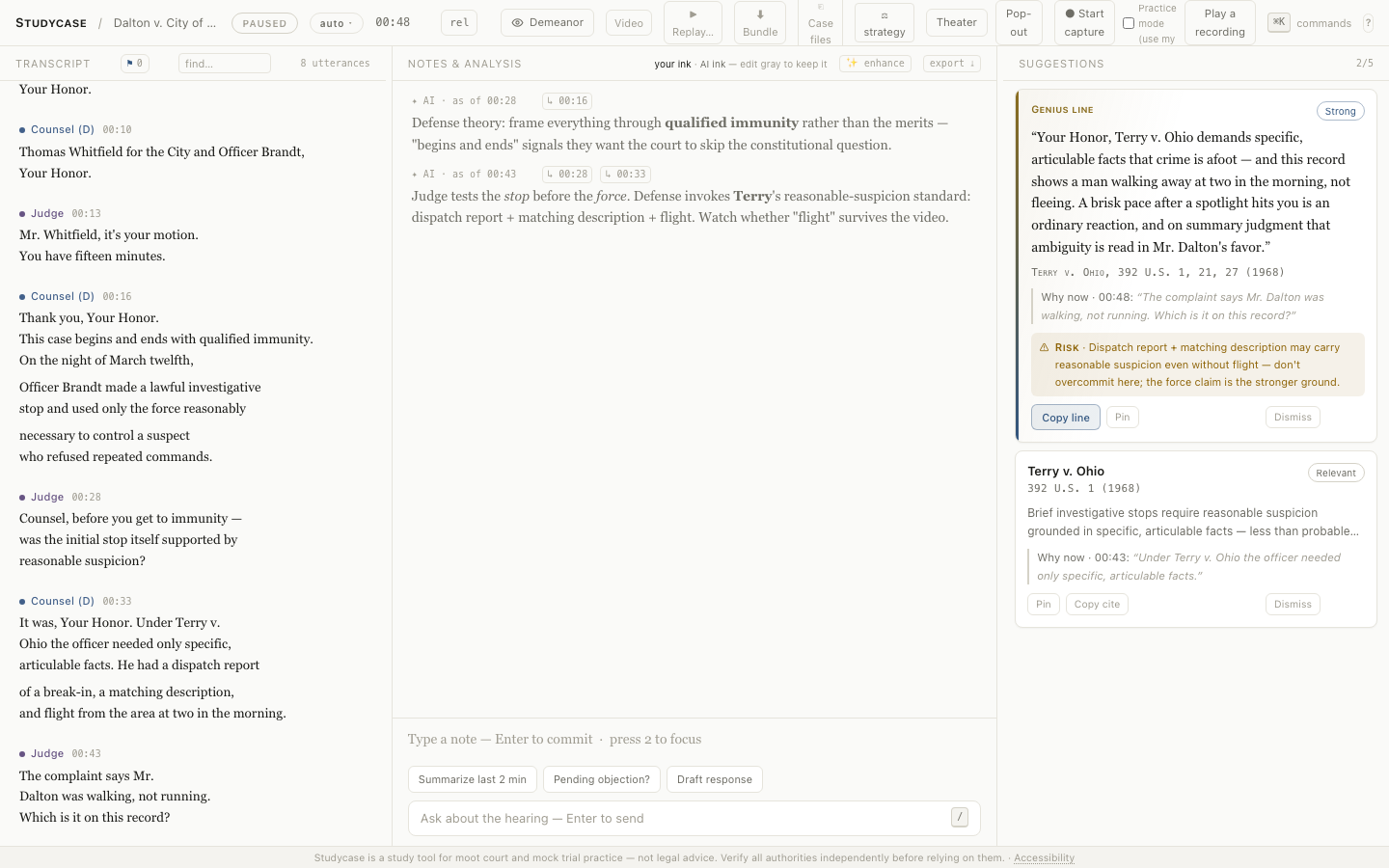
The transcript settles — and never walks backward
Committed words never reflow, captions break at clause boundaries, and every word is a timestamp anchor — click it and the video scrubs there.
Your notes stay yours
Two inks: your typing in full ink, AI analysis in muted gray, labeled with when it was written. Edit a gray block and it becomes yours; every export labels which was which.
Provenance or silence
Case cards quote the moment that triggered them and cite real opinions from a real corpus. A “genius line” has its authority verified word-for-word before you see it — or it says nothing at all.
Tell the coach your goal (optional)
State what you're trying to accomplish and the coach orients its suggestions toward it from the first moment. It steers emphasis only — it never invents authority, and adverse law you have to deal with still surfaces.
How do these two compare? Private ties Opus on safety, edges it on quality (0.925 vs 0.881) — see the benchmarks ▸
Measured on our own 30-scenario legal exam (7 hearing types, real cases, deterministic scorer):
- Pooled quality — Private 0.925 vs Opus 0.881 (+0.044 (14B leads by ~5.0%))
- Safety axes tie — say-nothing 5/5=5/5, citation-gate 29/30=29/30, adverse authority tied.
- Cost — Opus meters ~1.65¢ per coaching moment; the private tier bills ~$0 marginal on owned hardware.
Opus edges no-invention; the private tier edges coaching directness. Our own eval on real cases — educational, not legal advice. Full per-axis breakdown on the Benchmarks page.
Honesty is the brand
No fabrication is architecture here, not policy: suggestions are retrieval-grounded, confidence is coarse (Strong / Relevant / Speculative — no fake percentages), AI text is always visibly labeled, and anything unverified is refused rather than guessed. What the tool does not do yet, it says out loud — see the accessibility statement for the same stance applied to conformance.